CA as a Business Advisor vs. Book-keeper: What Business Owners Should Know
April 19, 2026
Business Owners (especially new businesses and small to medium enterprises (SMEs)) do not often appreciate the role of a Chartered Accountant (CA). Many business people view a Chartered Accountant primarily in terms of bookkeeping functions – as people who keep records of business transactions, handle the filing of GST returns and prepare year-end financial statements. Although these are important tasks and CAs perform bookkeeping services and assist businesses with preparing financial statements, this limited scope of services fails to appreciate the potential strategic contribution a Chartered Accountant can make to your business entity.
CAs can be extremely valuable as a trusted advisor to your business by helping you to make more informed business choices, reduce the level of risk you face as a business owner, improve your profitability, and position your business for growth in the future.
In this article, you will learn about the differences between a Chartered Accountant and an accountant (bookkeeper), where each fits in the structure of a growing or start-up business, and how to leverage the best Chartered Accountancy Firm’s experience and expertise to your advantage.
Understanding the Book-keeper’s Role
The main function of a book-keeper is to manage the documentation of all money transactions made by the business, so that the books are well organised, complete, and accurate.
Some of the tasks performed by a book-keeper are as follows:
– Recording daily cash transactions.
– Keeping ledgers and journals.
– Reconciling bank accounts.
– Monitoring invoices, bills, and payments received or made.
– Reporting basic financial results like a trial balance.
In summary, a book-keeper plays a vital role in keeping the company’s financial transactions recorded in a good order. Accurate and timely books provide the basis for the company to fulfil statutory obligations, prepare reliable financial statements, independent audits, and prepare tax returns. However, most book-keepers deal exclusively with archived information, since they only keep a record of what has already been completed.
Therefore, the book-keeper is the person responsible for telling you how much money you spent or earned and from where.
To make this work easier than ever, cloud technologies and outsourcing have revolutionised the bookkeeping function in the modern era, enabling business owners to continue to manage their business books without the need for a physical in-house book-keeping team.
The CA as a Business Advisor: A Strategic Partner
The advisory function of a Chartered Accountant (CA) isn’t just limited to recording transactions. CAs possess a skillset that includes analyzing numerical information to identify trends and transforming numerical information into insights that will permit a company to grow sustainably. This is what gives a chartered accountant the ability to be an advisor in business. They have:
- An in-depth knowledge of taxation, finance, and all applicable regulatory frameworks
- A capability to interpret financial data in conjunction with the operations of an enterprise
- A background in working with enterprises at all levels of the cycle of growth
- An ability to take a forward-looking and strategic perspective.
In this respect, the CA helps businesses not just go back in time, but to plan for the future. Simply put, a CA can provide you with information to make future decisions regarding the use of your finances.
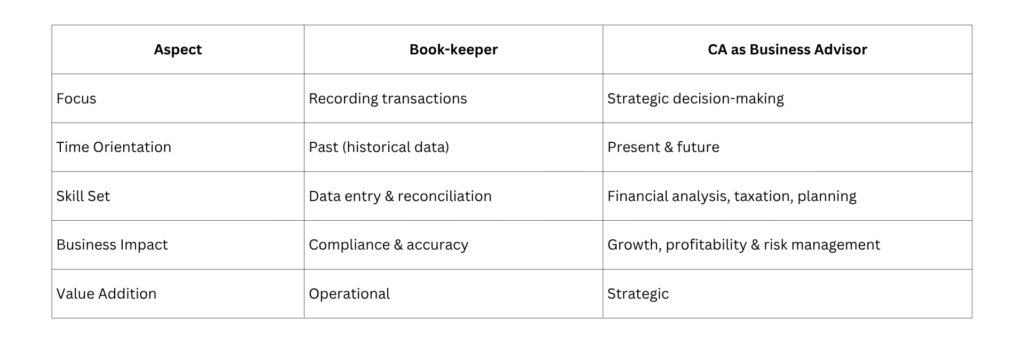
Key Differences: Business Advisor vs. Book-keeper
How a CA Adds Strategic Value to Your Business
- Budgeting And Projections Are Made With Realistic Expectations
Professional Chartered Accountants (CAs) prepare monthly cash flow forecasts and project budgets to allow businesses to plan for their growth, investments or downturns.
- Tax Return Preparation And Compliance
CAs not only prepare income tax returns but will also provide assistance when selecting business structures, restructuring business transactions and creating tax efficient expense structures under the Income Tax Act to allow you to legally reduce your overall tax liability while remaining compliant with the Income Tax Act.
- Business Structuring Assistance
CAs provide assistance in structuring and growing your business by advising about launching new products, entering new markets and obtaining new capital debt/equity (capital structure), optimising costs, creating pricing strategies and outsourcing your bookkeeping and accounting functions gives you access to a higher level of accounting expertise without having to hire a full time employee.
- Identifying And Managing Risk
CAs can assist in identifying and addressing potential regulatory and financial risks that may occur in your business before they happen, including identifying GST cash flow gaps, potential future audit issues, and statutory non-compliance issues.
5. Performance Analysis
A CA doesn’t just prepare financial statements—they analyse them. Key ratios, margins, cost structures, and trends are interpreted to help owners understand what’s working and what’s not.
Where Bookkeeping Ends and Advisory Begins
Most business owners think that using a CA isn’t necessary until audit season or tax filing due dates come around. Waiting until these times put businesses at risk of missing opportunities and making avoidable mistakes with their books.
While bookkeeping answers questions about:
- What’s our total expenses from last month?
- Is our bookkeeping up to date?
- Did we enter every invoice we received into our records?
Advisory help business owners and management answer questions such as:
- What are the reasons for dropping margins?
- Do we have money available to bring on another employee?
- Is now the best time to grow?
- What steps can we take to make sure we’re collecting from our customers sooner than later?
Successful businesses for the long haul know that numbers aren’t just bookkeeping records, rather, they’re signals.
Outsourcing: A Smarter Approach for Modern Businesses
Hiring full-time financial professionals is expensive for small and midsized companies; therefore, many companies now rely on outsourced bookkeeping and outsourced Accounting services.
The combination of a bookkeeping and accounting service provides:
- Daily bookkeeping supported accurately
- Regular periodic reviews of total business
- A Network of Chartered Accountants from whom you may receive strategic advisory services when you need them
- Lower operational costs, which allows businesses to concentrate on growing and scaling by not having to pay for overhead cost; and
- The ability to make changes to how you use the services as your business grows.
When you partner with a prestigious chartered accountancy firm, you will not only have access to compliance support, but you will also have a financial partner who understands your overall business goals.
Mistakes Most Business Owners Make:
One of the biggest mistakes business owners make is treating their accounting as an expense rather than an asset. Business owners want the cheapest bookkeeper available to them without thinking about the long-term value of having a financial adviser.
As a result of this mistake, businesses often experience:
- Poor cash flow management
- Tax inefficiencies
- Lost opportunities to grow
- Scrambling at the last minute to prepare compliance documents
When you have a qualified CA working with you throughout the year (not just at tax time), you avoid all of the pitfalls outlined above.
Which Do You Really Need?
You need both!
To comply with regulations, the primary function of bookkeeping is ensuring the accuracy of the business’s financial records. However, as an experienced business advisor, your CA should also help you to:
– Determine possible options for informed decision-making,
– Plan to grow your business,
– Identify ways to maximize your business’s profitability,
– Protect your business against both internal and external risk factors.
Some of the most successful businesses do not ask themselves, “Do I need a CA?” Instead, they ask the question, “How will having a CA help my business grow?”
Final Thoughts
In today’s challenging and heavily controlled business landscape, simply having a bookkeeping service is not enough. Business owners who consider their CA as a valuable asset will be able to gain clarity, confidence, and control over their company’s finances.
From start-ups, developing SMEs, and established corporations, working with the top chartered accountancy firm and utilizing outsourced accounting services will elevate the finance function within your business from a compliance obligation to a powerful business growth tool.
At GJM & Co., we believe that accounting is more than just numbers; it enables better decisions. By combining accurate bookkeeping with effective strategic advice, we can help your business evolve from simply managing a company’s finances to mastering them.
If you’re looking for support with accounting, cash flow management, or financial planning, GJM & Co. can help. We offer a wide range of services including bookkeeping and accounting, financing, taxation, business formation, and payroll management across industries. To know more, email us at info@gjmco.com or schedule a call with our team.